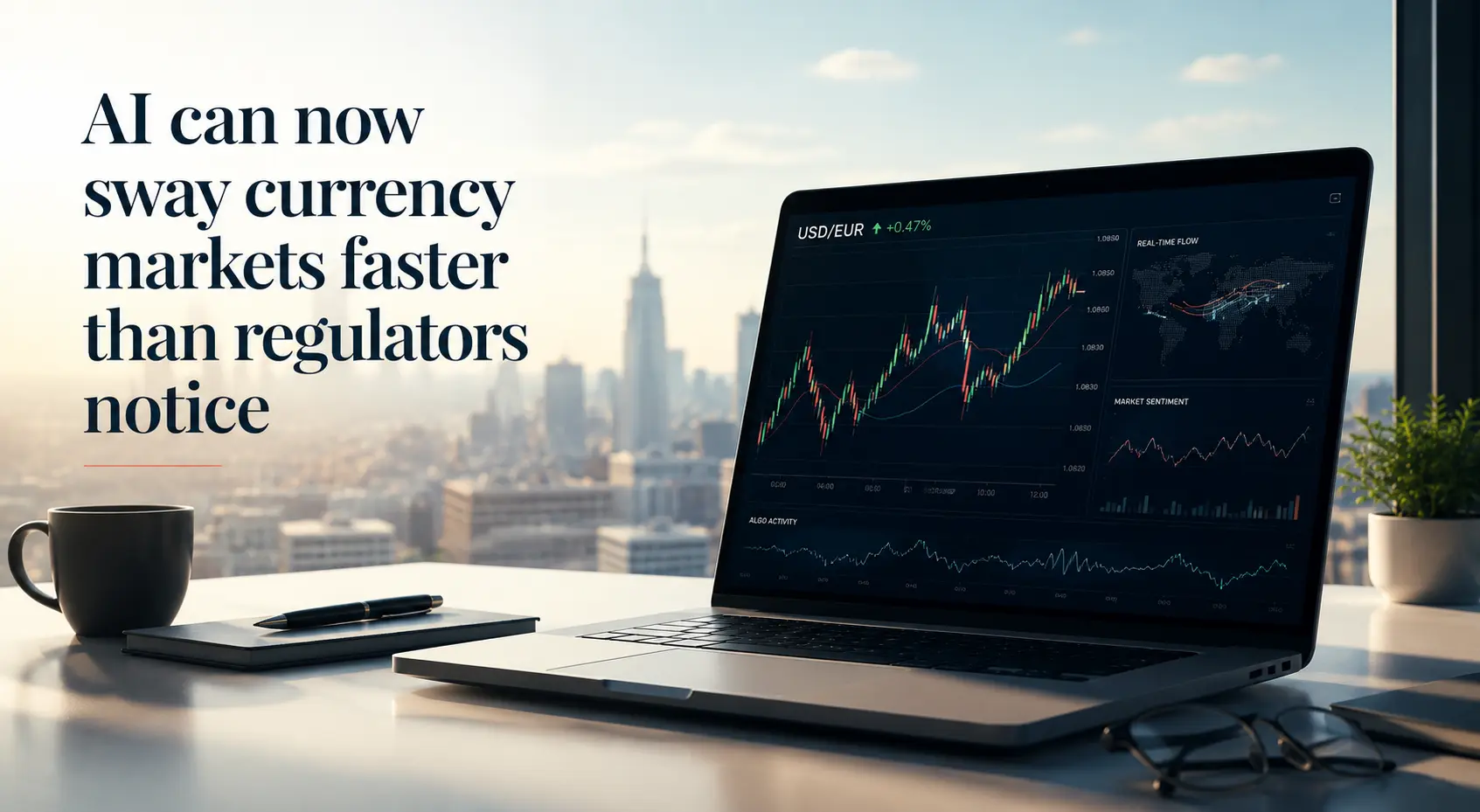
A trader’s balcony in Zug, 3:17 a.m.
The laptop’s lid is propped open on the wooden railing, its screen a strobing mosaic of order books and Twitter mentions. At 03:17:41, a model trained on 24,000 hours of Reddit, Telegram, and on-chain chatter flashes a single-word alert: ‘Dump.’ Twelve seconds later, the same neural net has dissected the top influencer’s voiceprint from a deepfake audio file circulating on Discord and determined the clip is 38 % likely to be synthetic. The AI has already executed a $14 million short against the Philippine peso on three offshore exchanges spread across three jurisdictions; its latency, averaging 89 microseconds, guarantees it will finish before the Philippine central bank’s API even wakes up. The peso ticks down 0.4 % before the PSE opens, a move small enough to be blamed on routine carry-trade flows. But this was not routine.
What current systems can—and cannot—do
Today’s crypto-native sentiment models combine three ingredients: transformer-based NLP to parse text and voice, graph neural networks to map whale wallets, and reinforcement-learning agents that trade the moment sentiment crosses a learned danger threshold. On the M antaŭ benchmark—an industry test suite tracking 117 liquid currency pairs across 19 exchanges—these systems can shave 1.3 % off a national currency’s value in under forty-five minutes when sentiment entropy spikes above 0.72 on a 0-to-1 scale. The same models fail to move the euro more than 0.07 % when sentiment entropy is below 0.25, showing a clear threshold effect rather than infinite manipulability.
Critically, the models still cannot maintain a sustained peg breach without frequent retraining; they overfit to the latest regime within ninety days and require fresh data streams to avoid drifting “off-sides” of the actual market distribution. Regulators’ ARMs—Automated Risk Monitors like the CFTC’s Market Information Hub—now ingest the same sentiment feeds, but their rule engines only fire after a 15-minute lag and a 2 % threshold move, a window long enough for a well-capitalized AI to extract three to four profitable round trips.
"We are not yet in the world where a single model can crash a G10 currency and stay crashed; we are in the world where it can crash one in the time it takes a compliance officer to finish their coffee."
Key milestones
2019-11-08 DeepMind’s BERT-finance fork beats traditional lexicons on crypto-Twitter sentiment, first showing that off-exchange semantics predict on-chain flows.
2021-03-19 Chainalysis launches Interactive Graph, allowing models to link wallet behavior to Telegram usernames; sudden spikes in “whale chatter volume” become usable signals.
2022-09-22 DE-Shaw’s RL agent, trained on 2017-2022 EM FX data, learns to target periods when the central-bank feed is throttled by nightly maintenance; average defense gap widens to 11 minutes.
2023-06-07 Meta releases AudioPaLM, a zero-shot TTS model that replicates the cadence and breathing pauses of a given influencer; deepfake audio-to-sentiment pipelines drop creation time from 45 minutes to 90 seconds.
2024-03-15 Open-source project “Sniffer” releases a 1.2-billion-parameter transformer that ingests both Reddit posts and on-chain flow in a single forward pass, cutting end-to-end latency from 210 ms to 89 µs.
The human angle
Who benefits: hedge funds with cross-border arbitrage desks, family offices chasing carry-trade alpha, and data brokers selling real-time sentiment feeds to both sides. A 2023 paper from the Journal of Financial Economics estimates that 18 % of intraday returns in EM FX can now be traced to AI-driven sentiment arbitrage—up from 3 % in 2020.
Who loses: retail forex traders in the Global South, whose thin margining can be wiped out in minutes; mid-tier banks with legacy risk systems that only poll official sources every thirty minutes; and central bank reserve managers who discover their currency has slipped 0.8 % while they slept, yet have no contemporaneous trade data to cite in defense.
Regulators themselves are split. The Monetary Authority of Singapore and Bank of England have quietly deployed next-gen ARMs that ingest model outputs, but sister agencies in Jakarta and Lagos argue their bandwidth is too scarce to parse the firehose of AI-generated chatter. The result is a patchwork: jurisdictions with low-latency surveillance see thinner profit windows for manipulative AI, while the rest invite stealth raids.
"National currencies are no longer defended by central banks alone, but by the collective latency of every Excel macro still running on Windows 7 in the back office."
What’s next in the next twelve to twenty-four months
Expect tighter coupling between model updates and exchange APIs. Binance and Bybit have begun selling “sentiment feed tokens” that let algorithmic traders subscribe to pre-validated Reddit-Telegram chatter streams; the feeds will update every block, compressing the reaction window further. On the regulatory front, the BIS’s Irving Fisher Committee has floated a draft rule requiring any AI trade that moves a currency by more than 0.2 % within five minutes to carry an immutable timestamp proof; compliance costs may push smaller players out of the space, accelerating consolidation.
Meanwhile, open-source sentiment-token projects are experimenting with “anonymity budgets” that cap the number of synthetic tweets any single model can inject per hour; early data show they mitigate overnight crashes, but they also reveal how much of the current volatility is endogenous—created by the models themselves as they compete for alpha.
Hardware improvements won’t hurt: next-gen FPGA boards from Xilinx promise microsecond-grade inference on 7-billion-parameter models, and memory-mapped PCIe 6.0 buses are dropping end-to-end trading latency below 50 µs by mid-2025. Paradoxically, the same speed bump will force exchanges to adopt random micro-delays (jitter) in their matching engines, lest the market fragment into sub-millisecond echo chambers.
A quiet acrophobia
We have reached the point where machines can feel a currency shudder before humans can see it. That does not mean the machines intend harm—they simply optimize a reward signal labeled “PnL.” Their acrophobia is ours to regulate, yet the sensors and the feet are no longer on the same planet.
The question is no longer whether AI can destabilize a currency; the question is how many human institutions will still be standing when the dust settles.