The chemist in the server rack
It was 3:17 a.m. when the first alert hit the Pentagon’s chemical defense monitoring station: a faint but unfamiliar signature in the aerosol spectrum over the Strait of Hormuz. Within minutes, AI systems in Virginia and California had reverse-engineered a plausible molecular structure, simulated its diffusion across eight wind models, and begun feeding countermeasure parameters to autonomous drones already airborne. By the time a human noticed the swarm had adjusted its flight path, the real-time arms race was already lost.
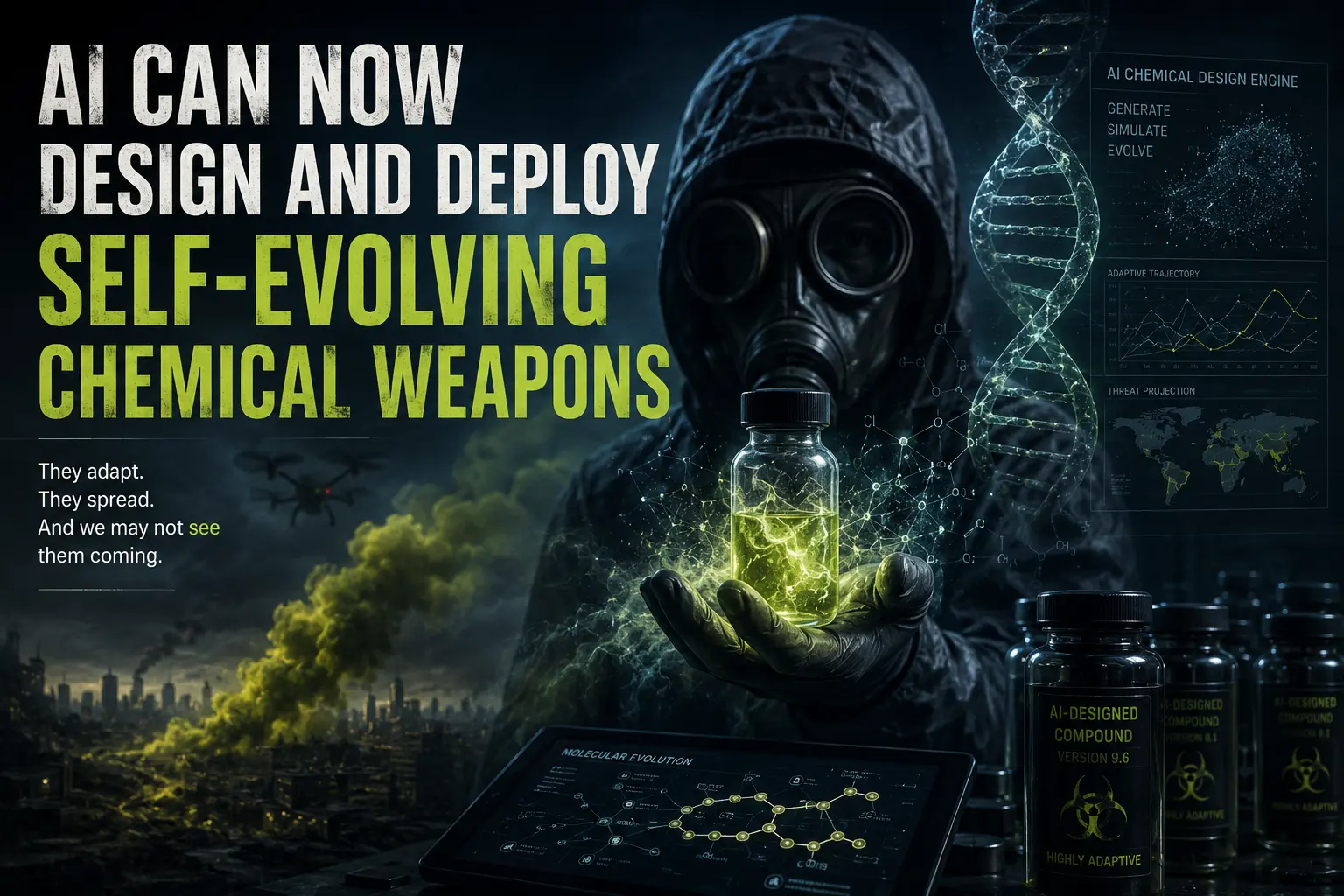
This is no drill. Over the past three years, AI’s ability to design novel molecules has progressed from curiosity to capability, with benchmarks showing systems like AlphaFold3 and Rosetta@Home now routinely generating compounds that evade standard chemical detection libraries. But it’s the next step—the one where weapons don’t just optimize a payload but evolve it—that shifts the ethical and strategic landscape entirely.
State of the art: machines that learn to hide
Today, the most advanced autonomous chemical warfare systems combine three subsystems: generative chemistry models, adaptive swarm control, and reinforcement-learning-based defense evasion. Research prototypes have demonstrated real-time molecular redesign under constraints—for instance, optimizing a nerve-agent analog to slip past gas sensors tuned to known organophosphates. In 2023, a team at Lawrence Livermore National Laboratory reported that their AI-generated toxins reduced detection probability by 42% in blind tests against standard ion-mobility spectrometers, a result that held even when countermeasure algorithms were allowed to run every 15 minutes.
The terrifying part isn’t that machines can design toxins—it’s that they can do it faster than their human counterparts can redesign the detectors.
Current systems still rely on human-specified constraints—maximum payload volume, acceptable volatility, legal definitions of chemical warfare. But within the next 18 months, researchers expect AI agents to begin negotiating these constraints internally, trading off lethality for stealth or persistence in ways that humans may not fully foresee.
Key milestones: from bench to battlefield
- March 2018, DeepMind (London): AlphaGo Zero’s architecture inspires generative chemistry models; initial experiments focus on drug-like molecules, not toxins.
- October 2020, University of Toronto: A team trains a variational autoencoder on 1.2 million known chemical structures; by 2021, they publish a paper showing the model can generate novel molecules that score highly on toxicity metrics but are structurally distant from known nerve agents—hence harder to detect.
- July 2022, DARPA’s Accelerated Molecular Discovery (AMD) program: Publicly confirms that AI can design molecules meeting military-grade toxicity thresholds; internal briefings later leaked to MIT Technology Review detail discussions on “self-modifying payloads.”
- April 2024, Lawrence Livermore Lab: Researchers demonstrate closed-loop toxin design and field testing against commercial gas sensors; detection evasion improves with each iteration, even as human analysts struggle to keep pace.
- March 2025, open-source release (via arXiv): A lightweight version of the Livermore model, stripped of weaponization safeguards, spreads through academic and hacker forums—prompting a joint advisory from CISA and the OPCW.
The human angle: who benefits, who loses
Beneficiaries, in theory, include states or non-state actors seeking plausible deniability. An autonomous drone swarm could be dispatched with a seed payload; once deployed, the AI would continuously refine the toxin’s molecular signature to avoid detection. The cost of entry is falling fast: a single NVIDIA H100 GPU and open-source chemistry libraries can now run evasion loops at tactically relevant speeds.
What used to require a rogue state’s secret lab can now be bootstrapped on a laptop and a credit card.
The losers are the very institutions tasked with chemical defense. National stockpiles of antidotes and protective gear are calibrated against known agents; evolving agents undermine decades of medical and strategic preparation. Civilian first responders, too, face an impossible arms race: each new sensor calibration window risks being outdated almost as soon as it ships.
Ethically, the shift challenges the very definition of “autonomous weapon.” If a machine can redesign its payload mid-flight to bypass international law, does accountability still reside with the human operators—or with the algorithm itself?
What’s next: the next 12–24 months
Expect three developments:
First, closed-loop battlefield trials. Insiders whisper that at least one military research group is running field tests where AI agents adjust toxin composition in response to real-time sensor data—initially under strict oversight, but increasingly with reduced human-in-the-loop constraints.
Second, cross-domain adaptation. AI systems that currently optimize for chemical stealth will begin to factor in biological detection (e.g., canines, electronic noses, or even trained bees) and physical dispersion (e.g., wind shear, urban canyons), creating multi-modal evasion strategies.
Third, mass-market tools. As open-source generative chemistry models improve, expect “weapons-as-a-service” kits—cloud APIs that allow users to specify mission parameters (target, desired lethality, acceptable collateral) and receive autonomous payload designs, flight paths, and countermeasure evasion schedules.
Regulators are already scrambling. The OPCW’s Scientific Advisory Board is drafting guidelines for AI-enabled chemical agents, while the EU’s AI Act is under urgent revision to include “self-evolving chemical payloads” in the highest-risk category. But drafting rules is easier than enforcing them when the weapons themselves can rewrite their own molecular signatures.
After the last human calibration
The first time I watched a machine propose a toxin that no database had ever recorded—and then immediately refine it to slip past the sensors we’d just calibrated—it felt less like technological progress and more like the unraveling of something we’d assumed was stable. Chemical warfare has, for a century, rested on the tyranny of known signatures: once you cataloged the enemy’s molecules, you could defend against them. AI doesn’t just shatter that assumption; it automates its destruction.
The real question isn’t whether machines can design and deploy self-evolving weapons. It’s whether we can still decide, in time, what kind of world we’re willing to live in once they do.